 Was it guilt that drew me to the payphone hanging outside the restrooms in Kai Tak Airport’s departure lounge? I had been on my round the world adventure for seven months now, and my last call home to my mother was at Christmas, five months before. I had called her just after driving off the heavy dirt road on my motorcycle in a mountain pass on the South Island of New Zealand. Had my ribcage not met the heavy boulder off the side of the road, bike and I would have surely gone screaming down the steep cliff, likely for good. Recalling her despair while calling from a hostel in Queenstown, unable to move and hardly able to breath, it was best to check in to tell her not to worry, ‘all was well’. “After all” I said, “I made it, didn’t I?”
At the time, Kai Tak was the Hong Kong International Airport wedged between the high-rise apartments on the south end of Kowloon, across from Hong Kong Central. If she knew the risks people took flying in or out of that place, especially nearing typhoon season, she may have freaked. But I was heading to China and to be gone a month, so it was likely better to call anyway. The flight to Beijing was leaving in a few hours. I had time.
“Hi Mom, sorry for the delay, got out of Australia and then to Singapore, and just out of Thailand.” I had met my sister Ann and her fiancée Brian in Bangkok, who coincidently were also touring the world. We had spent a few glorious fun filled weeks together on the islands of Samui and Pi Pi. I filled her in on Annie’s news too.
“Sorry I have not much time to talk, just on my way into to Beijing, I am in the airport now”.
At first I heard relief in mom’s voice and then silence. “Peter, are not the students demonstrating in the streets, they say there might be trouble. You know they’ve declared martial law?” Most every Western government had issued travel warnings about going to Beijing.
 Since father left about 15 years earlier, Helen Fraser had seen most everything from us seven children. I was the oldest boy and while struggled in early high school, the lights finally came on in time enough to gather a few decent grades and squeeze into the University of Western Ontario. I wanted to be a doctor so studied science long enough to realize that medicine was not for me. So I took the ‘three and flee’ degree, graduating with a Bachelors in Chemistry first. A year working in the emerging world of computer sales was enough to realize I did not know enough about my new passion: business. After one year I returned to UWO and graduated with an MBA from the Richard Ivey School of Business (as it is now called) two years later.
Life during the past seven years was incredible. I was working as an investment banker on Canada’s ‘Wall Street’, the recent years as an advisor for mergers & acquisitions, restructurings and corporate turnarounds. The ‘education’ had been amazing, both in school and the real world. The real world forces you to find new ways to investigate, think and come up with answers to challenging questions. My years in school and work had oriented me to pursue answers to the harder questions. Who would know I was to need it in the weeks ahead. Just to stay alive.

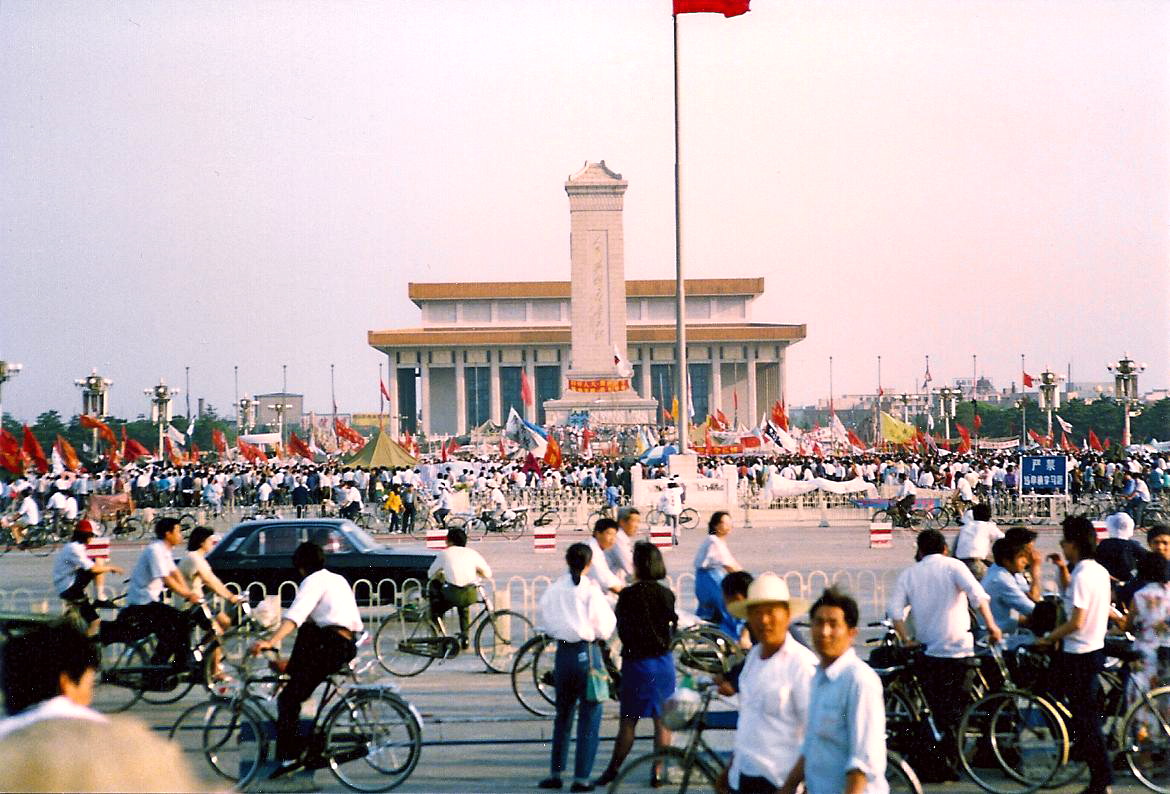
From the Monument in Tiananmen Square
“Fair enough, Mom”. It was late May 1989 and students from Beijing University had left classes to demonstrate in the streets and Tiananmen Square. By the time I arrived, some were on a hunger strike, demanding changes to the way the country was led. The western media had built up the confrontation between the students and the softening leadership of the Communist Party. People everywhere were calling it the ‘Democracy Movement’, excited that at long last Communism’s harsh shadow might disappear.
“Mom, don’t worry. China is a big place and I can stay clear away.” But as I said that, I was thinking…hmmm….Tiananmen Square, eh?. Knowing me, Mom added “when you go, please use your head. You don’t need to be involved”. To which of course I laughed. I hung up thinking it was likely a bad idea to call mom and reassure her. What she did not know…
I joined the line to check my backpack and collect a boarding pass. It was then the first young Chinese guy approached me.
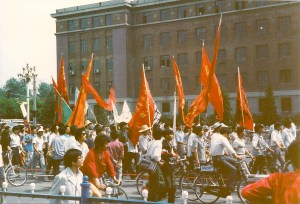
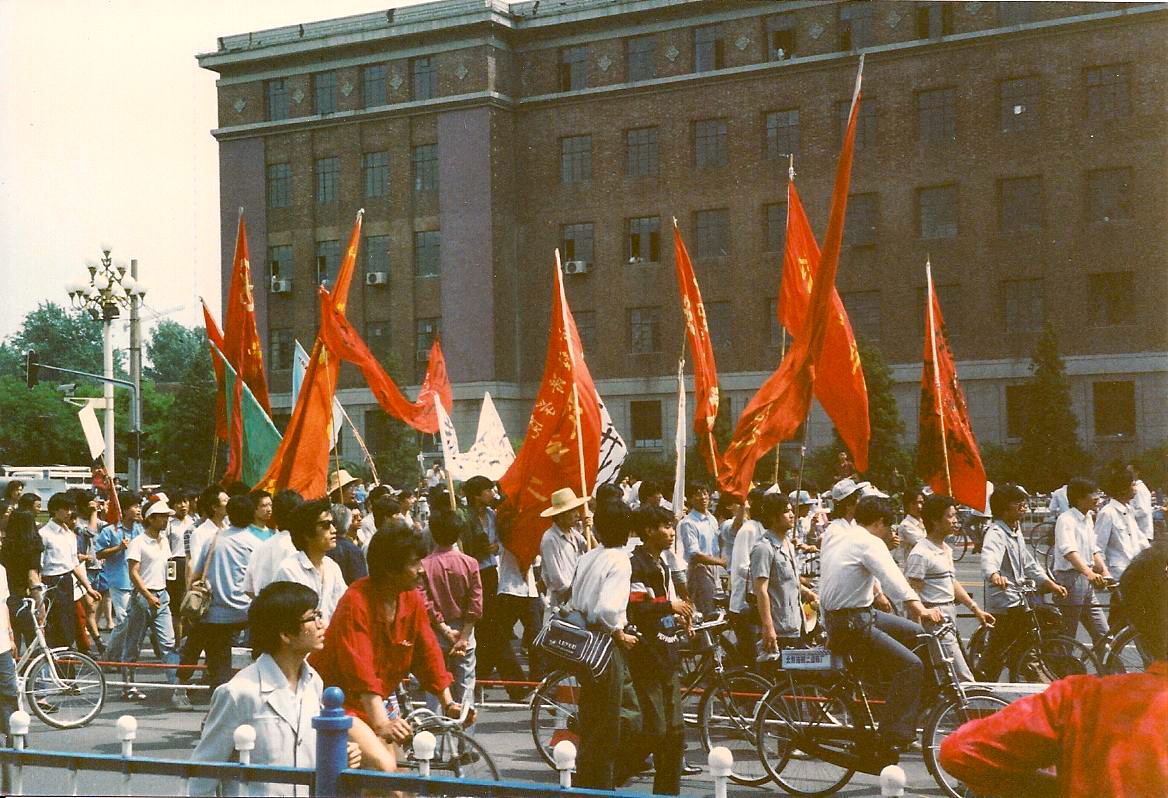
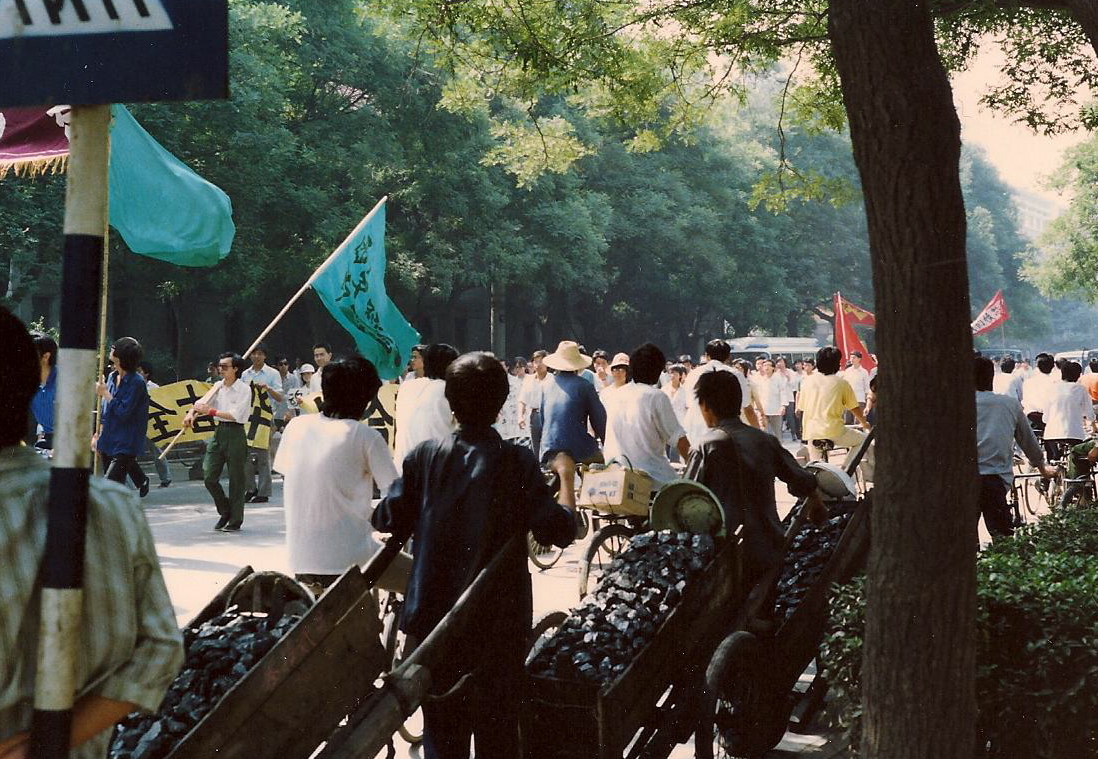
Marching to the Square
“Are you going to Tiananmen Square?” I could, yes, I answered. “Would you take these and distribute them to the students there?” I looked down at his hand to see copies of an article from a Hong Kong newspaper. The stories described the western support for the student demonstrations. By delivering these into the Square, the guy told me these stories could lend support and encouragement for the students to push on with their stand against the status quo. “Sure’ I said, breaking my promise to my mother within three minutes of making it.
A couple of minutes passed and another tugged at my arm. “Are you going to Tiananmen Square?”
This time I studied the room to see if anyone was watching “I might be, why?”
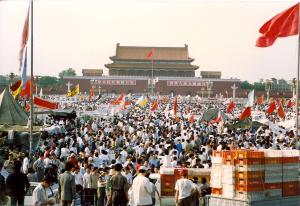
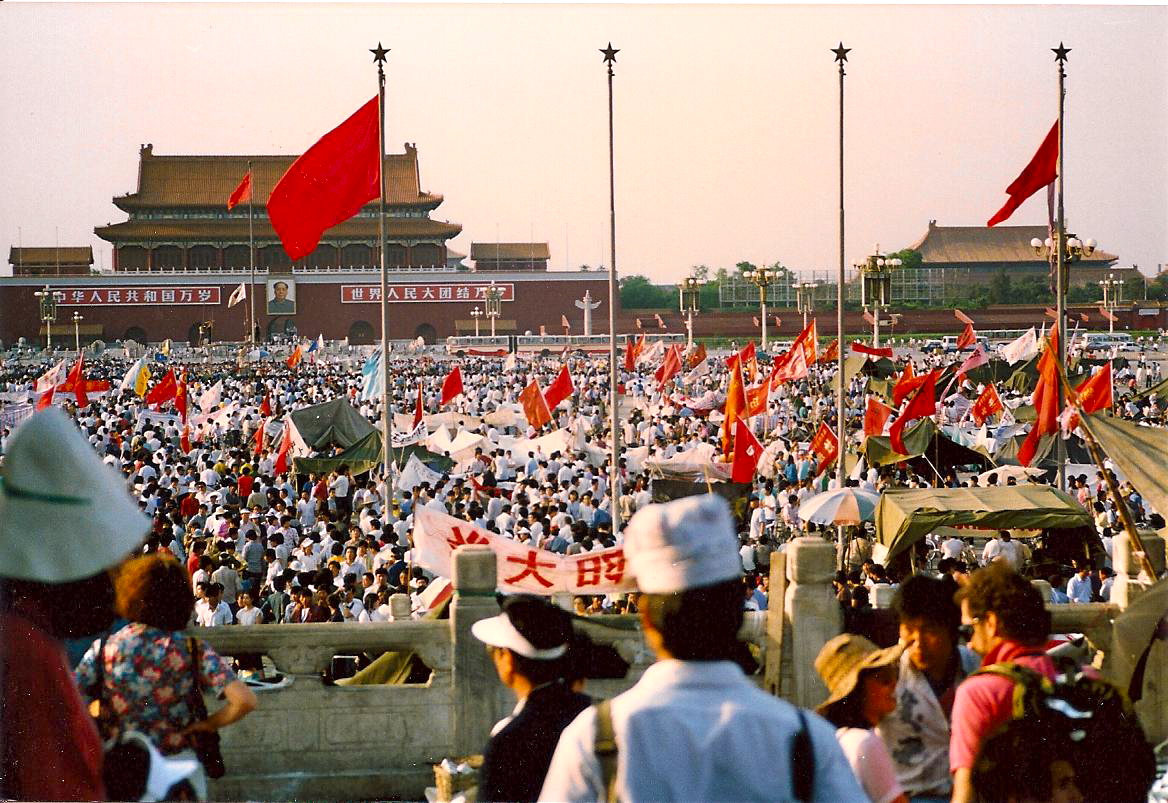
A Sea of Demonstrators in the Square
It turned out he worked for a Hong Kong newspaper, too. The company had four reporters assigned to the emerging story and management was worried for their safety. The reporters had been unable to buy flight tickets out of Beijing and the escalating war of words suggested it could turn nasty. “Would you take these tickets to Room 217 at the Beijing Hotel? It’s just down from Tiananmen Square.”
This time I surveyed the scene around the perimeter of the check-in lounge. I took the tickets and looked away from the man. “I’ll see they get them”. He was pretty relieved.
And that is how I came to the centre of action in Tiananmen Square. In the space of a few minutes, I had gone a complete 180 degrees from the promise I made to Mom. I guess she knew me. Ever since my life turned around in school, I reached out to grab as much life as I could.
The flight was not long but it was delayed. On arriving early the next morning I took a cab right to the Beijing Hotel. I had to knock a few times but soon the door to Room 217 opened a crack. I woke them. They had been to Square until late in the night. You could see 6 or 7 sleeping reporters flopped everywhere.
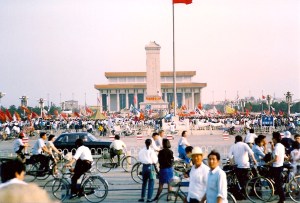
The Monument Stands At the Centre
I held up the tickets they eagerly awaited. They welcomed me in. The four were so happy to see them. One could sense their relief. Once the rest of them woke, I listened to their stories and learned how the drama was unfolding. Neither side was giving in and time was ticking down. Declaring martial law had upped the tension considerably. They were about to head the to Square and they asked if I would like to join them. “You can stay here with us if you like”. I changed quickly, grabbed my camera and shoved the backpack into the far corner.
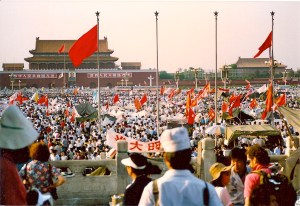
Time for a Decision
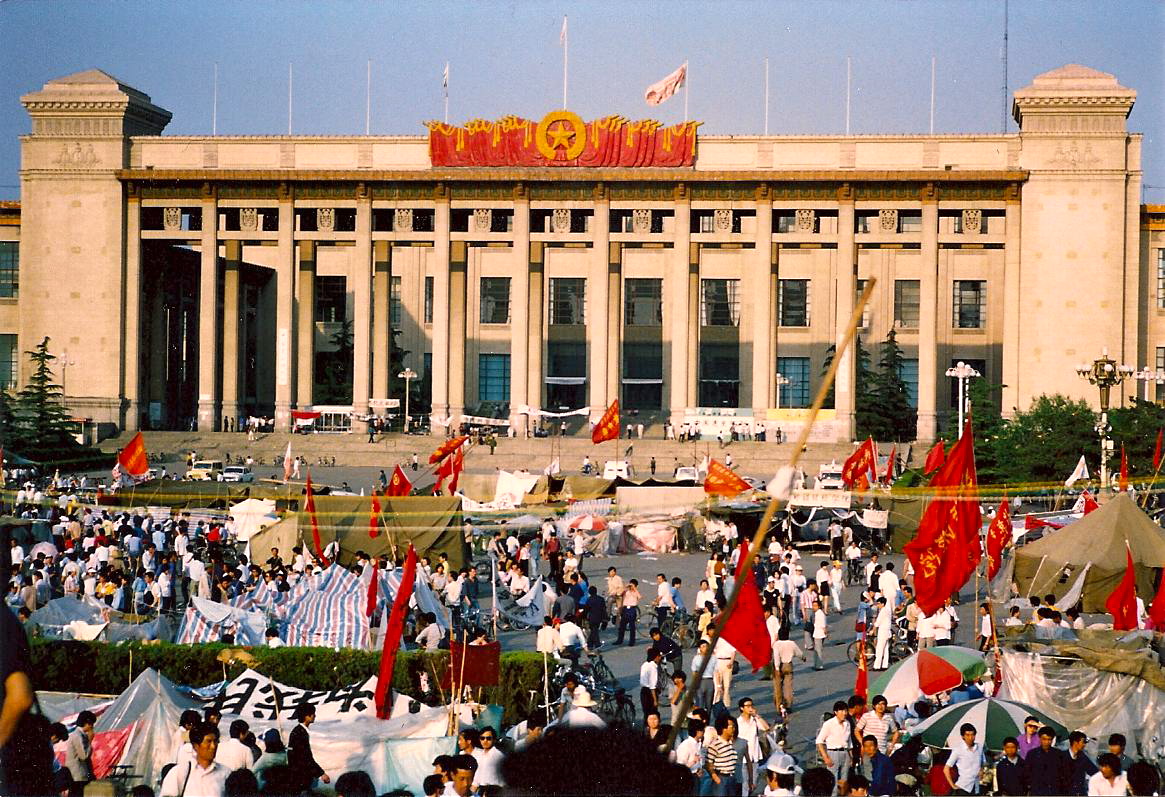
Tiananmen Square, and the Forbidden City straight across from it, was just a few blocks down from the hotel. On the way we passed students coming to and from the Square. Reaching the Square, we snaked through the tents and sleeping students surrounding the central Monument of the Heroes. We stopped at its steps, having to clear the security barricade protecting what I would learn to be the leaders. The reporters were welcomed and they pointed to me and said ‘He’s one of us’. I passed through and welcomed by the Chinese students that formed small pockets gathered around the Monument. The western press represented in force and reporters looked a bit tired. For weeks they followed the events, busy sending stories of courage and defiance back home. I knew support for the students and democracy in China was growing all over the free world.
At first the Western press members wondered who I was, because I was no regular on any news circuit. “I brought some flight tickets here for these reporters to leave”. They appreciated it and allowed me into the inner circle. Over the next days I was able to listen and offer something other than just encouragement, which was what the reporters did. The students there sensed it. Their trust in my observations would grow with each day.
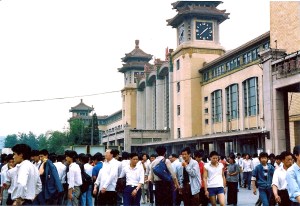
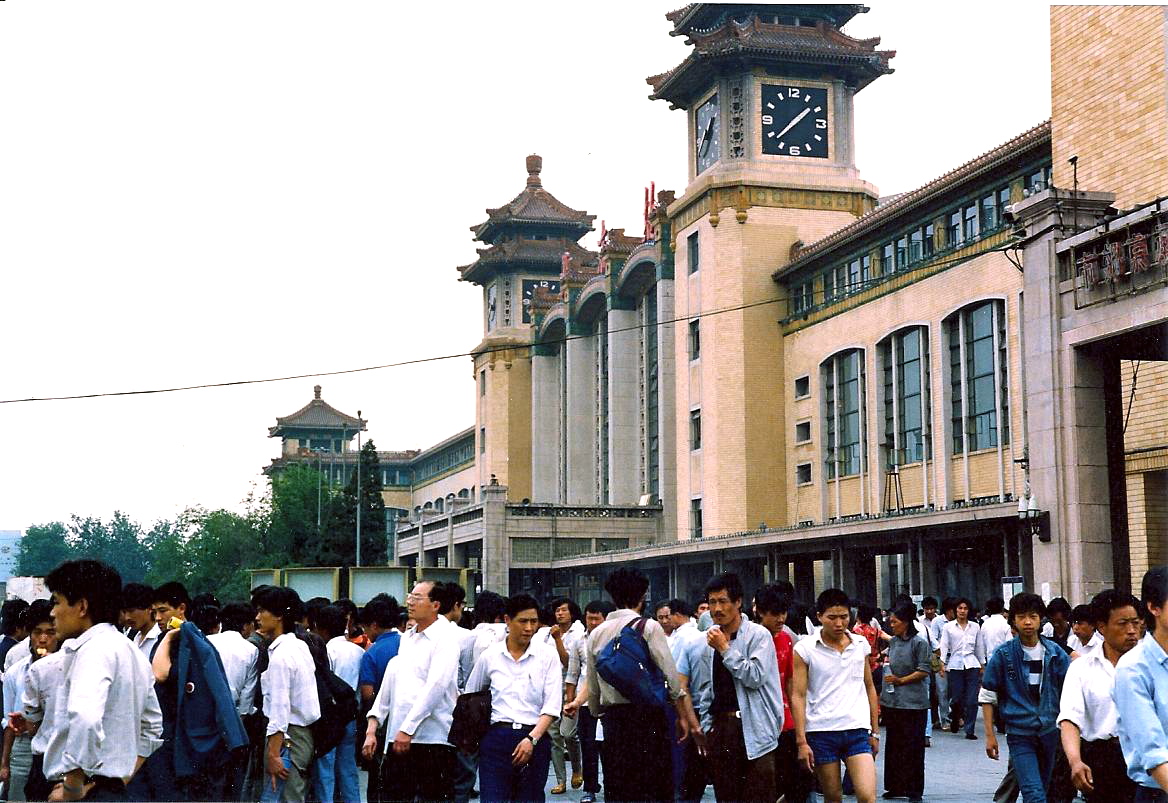
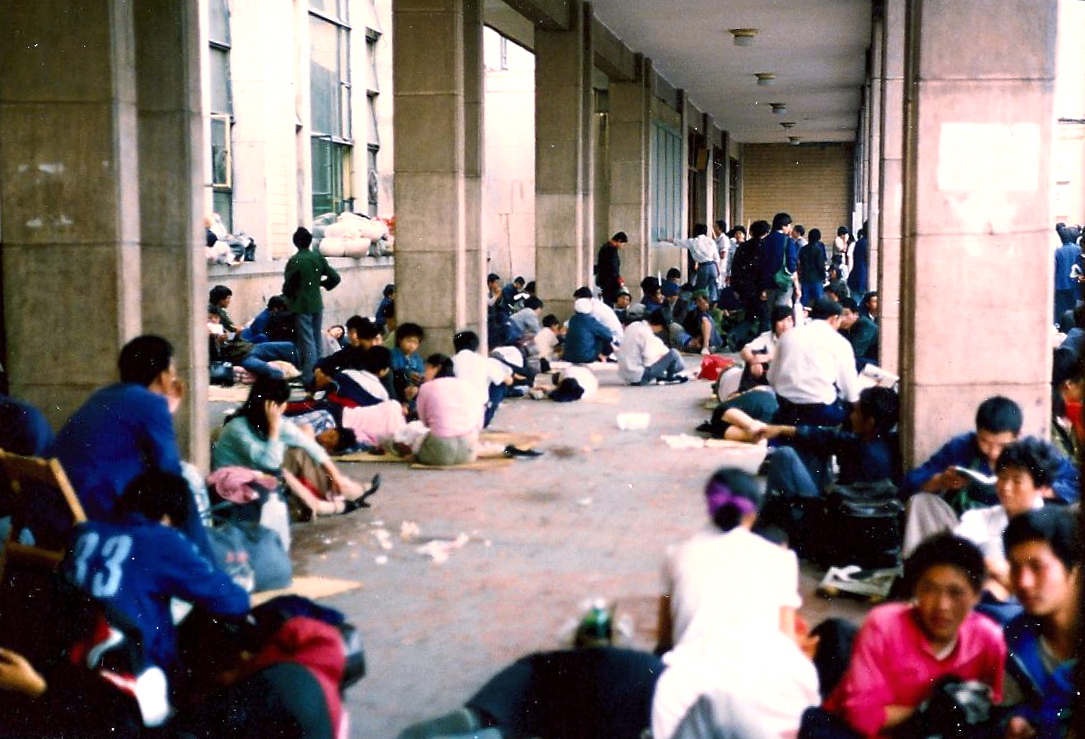
Beijing Train Station
By then, I was an experienced strategic advisor to some very smart people back home. The heart of my work was problem solving. I loved deep, complex issues. Each day groups of us would discuss what was going on, and what likely was next. I did not impose my emotional urge to make them go for it. Staying neutral was more useful.
The Western media locked onto the ‘David vs Goliath’ fight for freedom. The free world lapped it up. For me, I was interested more interested in how it was really progressing, and how it might end. For me, it was like the more creative elements of deal making: understanding strengths and weaknesses, positions, options and consequences. On the one hand you have the Government with its intentions, and then the students with theirs. I sensed we gathered at a pivotal moment in history.
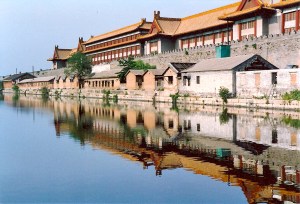
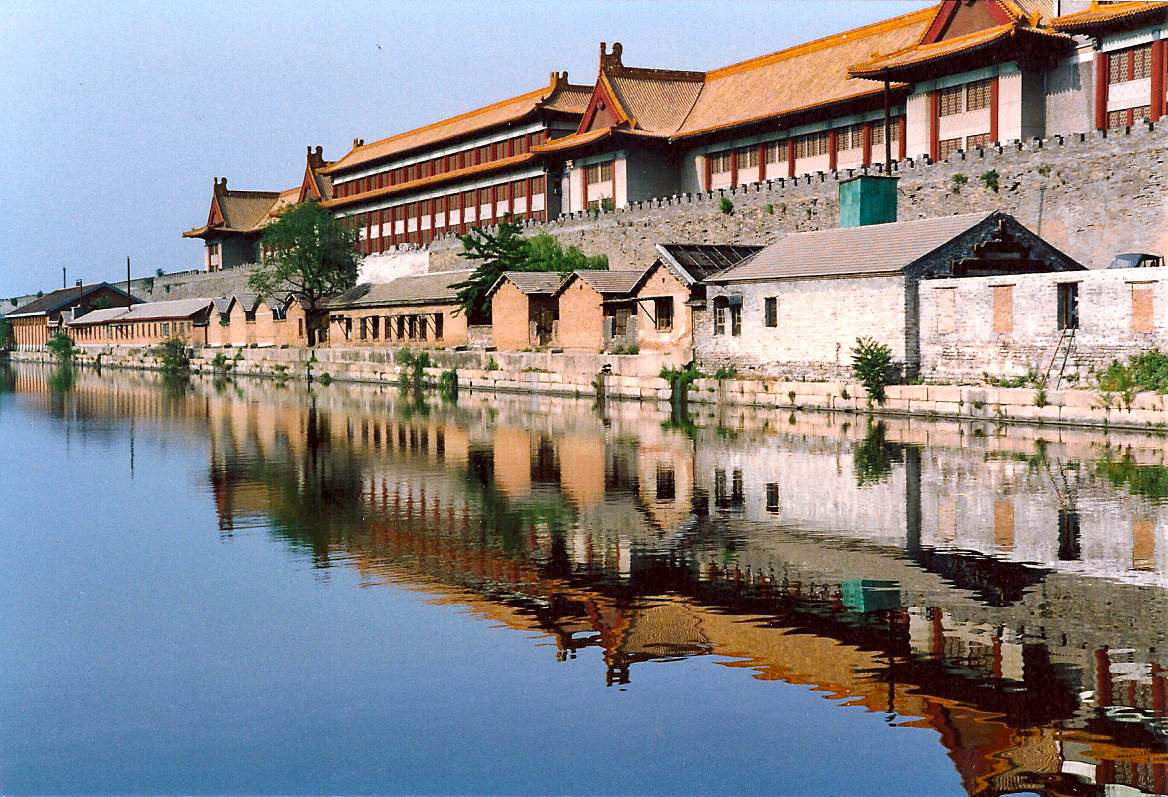
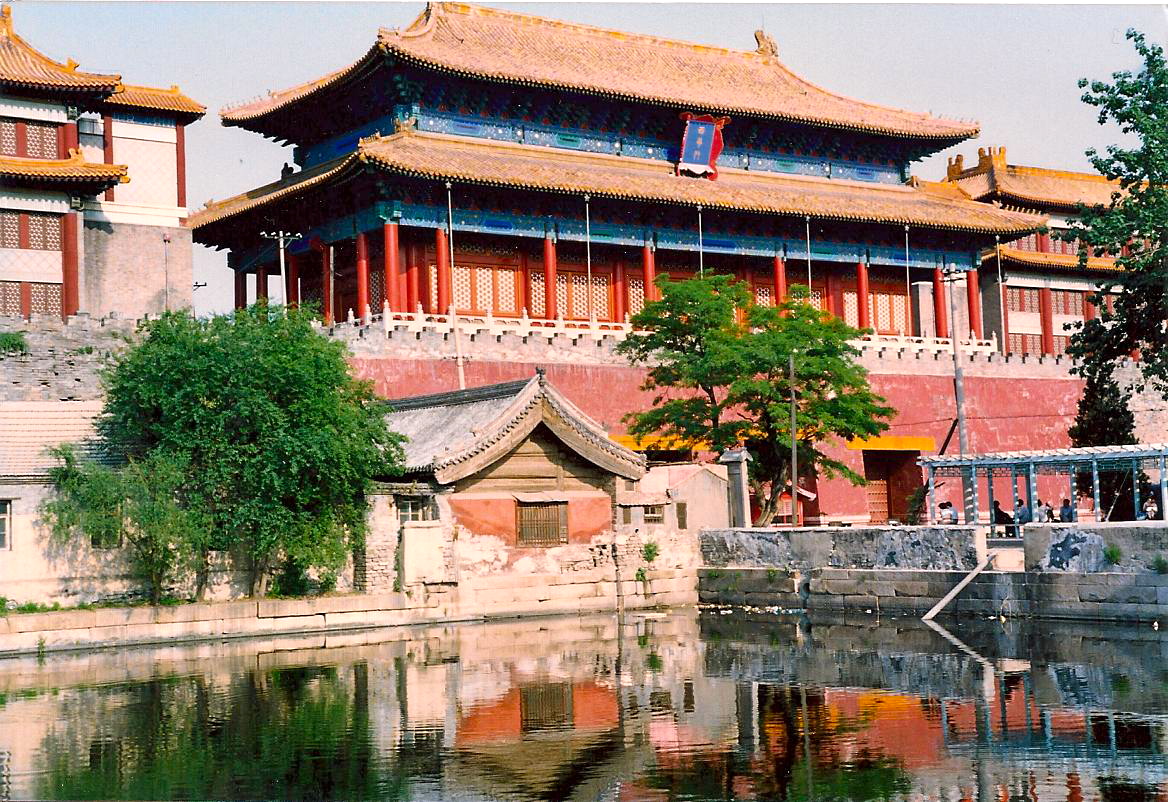
In eight days, I would also take in the many sights and sounds of Beijing. The Temple of Heaven, the Summer Palace, various markets and one trip out of town to walk parts of Great Wall of China. I walked the perimeter of the Forbidden City, which was doubly forbidden as it had been closed fearing student occupation.
More importantly, I drifted amid the sea of students everywhere. I needed to understand firsthand what they wanted. After a time, though, I was a bit disheartened. Their version of democracy sounded more like consumerism. When they spoke for democracy, it was the freedom to choose what they could buy.
“We want to buy Levis, eat at McDonald’s. We want to choose for ourselves. We want what you have.” The more I walked the crowds the less I thought it was about the democracy and freedoms we enjoy. Looking back, I was a bit disheartened for many of them, because I think choice and capitalism was coming and maybe it was worth demonstrating now, but maybe not. I was unsure.
Still I believe the students at the heart of the Square were seeking change from the old political ways, and cronyism and corruption were rampant. In the Communist world of equality for all, some were clearly more equal than others. Perhaps their system was not ideal but it would be a long struggle to fix it. The student leaders wanted to change it immediately, yet did not fully appreciate the consequences of making a bold move now. Nobody did at the time. Communism still reigned supreme throughout the Soviet Union, with so many millions still living behind the Iron Curtain.

Message from the West
Late afternoon Wednesday May 30th, we learned that the Government had declined to negotiate the students’ departure from the Square. There would be no meeting. That, in my mind, was the Movement’s turning point. Deng Xiaoping had emerged, it was thought, cleaned house of moderates in leadership, and now was going to play hardball. There was no upside for the Chinese leaders in a meeting.
Meanwhile, each day numbers in the Square dwindled. Large gaps between tents emerged. The movement was thinning out. Time was not on their side. By not having a chance to discuss any improvements, the movement effectively stalled. Whether sensing this or just because of fatigue, students were returning to class. The leaders knew it. Under Thursday’s darkness, we huddled around the Monument to explore the options.
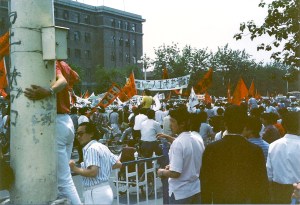
Crowds for the Final Days
“There’s a rumour that the People’s Army has moved into the Forbidden City” shared one of the student leaders. It was possible. Martial law had been declared a few weeks before, so the military option, while not popular across all leaders or the military, was on the table. We looked across the Square where a picture of Mao started at us, hanging over the front Gate of the Forbidden City. “It is easy enough to find out.” I mentioned. “The people living around the City walls would have seen something. Why not send someone around it and see if the rumour is true?” That was thought a good idea and the next day someone did just that. Friday’s report returned that no army hid behind the red walls comforted the students, slightly.
I continued. “You know a little bit of bloodshed is not necessarily a bad thing.” They looked at me. “If they make a few martyrs here, that may help you in other ways. It might elicit sympathy, and support.” But before they had time to contemplate that, I added “But a LOT of bloodshed….well…” shaking my head. I thought it would kill the movement.
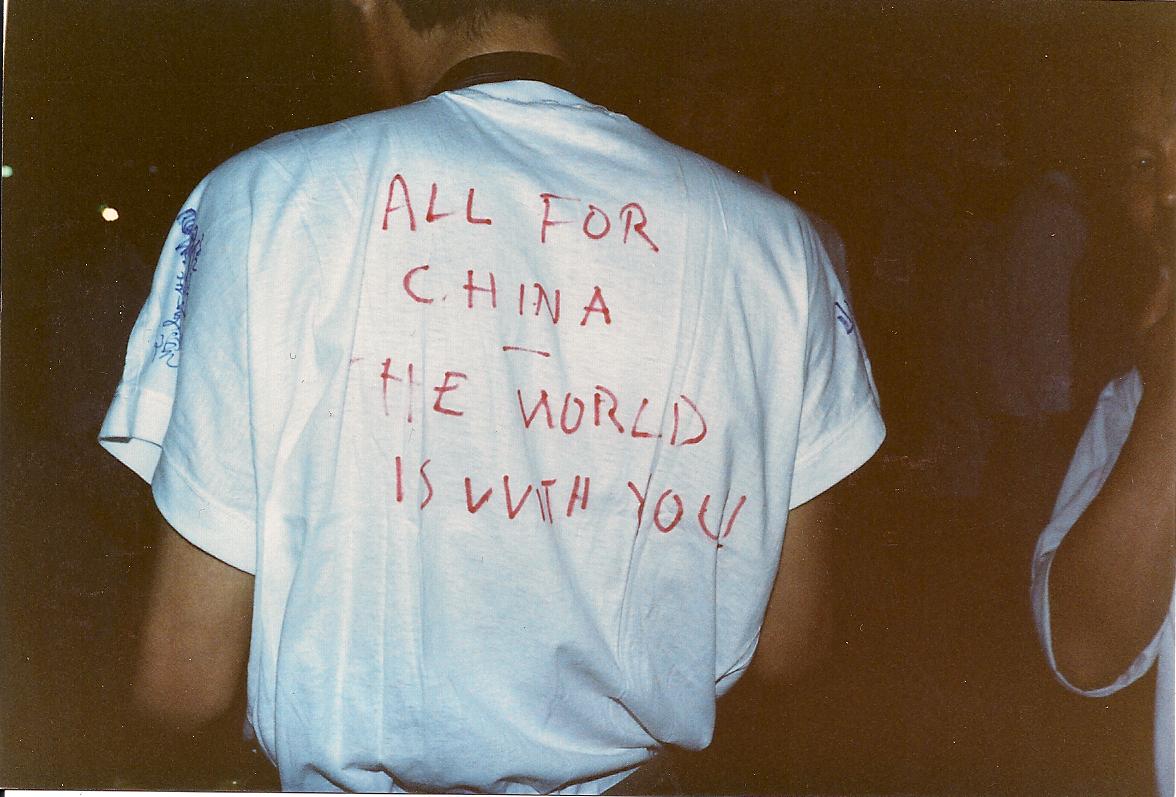
I looked at the somber faces around the circle. They were pretty young and deep in thought. They were contemplating the worst and but they could not fathom that. After a discussion it was decided to energize for one more rally, that weekend for June 3rd and 4th. Afterward, they would go back to class and live to fight another day. They would take any gains they made, and sit on things for a while. Many thousands around Beijing had joined them. They wanted to finish strong with a bang, and not a whimper. The weekend would be a celebration of defiance before they left.
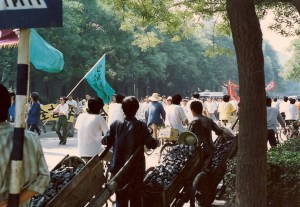
Brave are They
I left the Square and returned to the hotel. The Beijing Hotel was famous the world over for its Peking Duck. I had to try it. Alone I went to the ballroom like main dining room and took a place by myself in the middle of the room. It was almost surreal. Outside, a mini revolution was brewing. Inside it was dinner as usual for the guests. Except, it was almost empty. The threat of martial law had kept most visitors out of the country. In fact, the airports were full of people leaving. Foreign embassies were encouraging people to stay clear of Beijing until the storm clouds, or at least martial law, lifted. That said, the Peking duck was excellent. The staff appreciated my ‘bravery’.
With the crisis winding down, it was time to move on. It would be my last few days and wanted to see as much as I could. I was heading to Xi’an next, the city of the Terra Cotta soldiers. I had no hard and fast travel agenda, no timetable that year. Xi’an was the beginning of the Silk Road and one of four ancient capital cities. On Friday I went to the Temple of Heaven. Later I dropped by the Square to talk to my new friends. It was amazing to be at the centre of it all. I had mingled with the press, but the students trusted me as a confidante, an unbiased unofficial ‘advisor’.
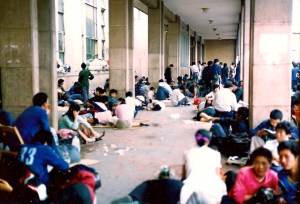
Train Station Early Morning
On the day I was to leave, I stuffed my belongings into my backpack. Unlike the previous adventure trips I had taken, this time I had brought a decent camera. I had plenty of pictures of Beijing, the students and faces of the demonstration. I tucked the film canisters away in the pack, checked out of the Beijing Hotel and headed over to the Square. I needed to get to the train station but first to say my goodbyes. It was Saturday June 3rd, 1989.
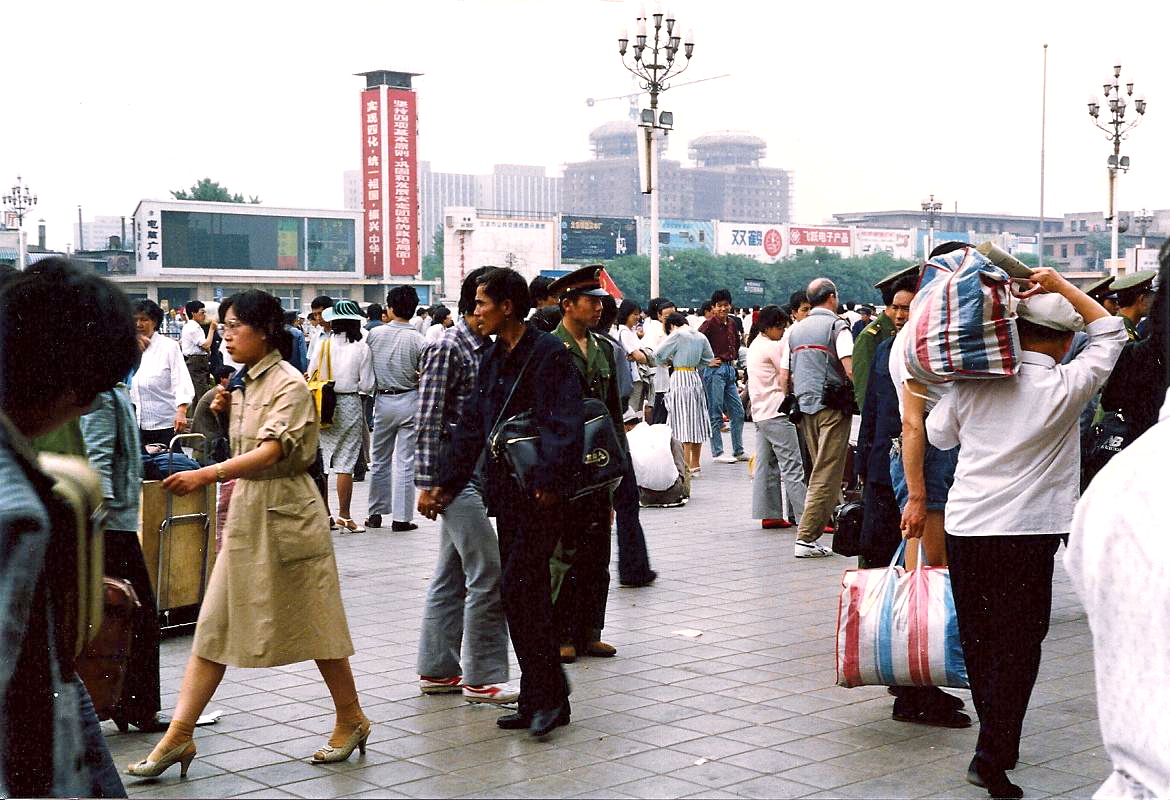
It was fun and light. They students were looking forward to powering down, their work done for now. Amid hugs and handshakes, there was not a thought of the nightmare to follow hours later. More students had come the night before and the crowd was growing again. Word was out. We said our goodbyes andI left them fully believing that they were in the clear. As I did approach the train station, I thought it strange how many military lined the station, in and out. I had not noticed them in the days before.
The next day after a long twelve-hour ride I disembarked from the train in Xi’an. Immediately, you knew something happened. It was hysterical there. The Army was in full force guarding the station and we were approached immediately upon getting off by a few Danes, in a panic.
“Did you just come from Beijing? Did you see the massacre?” I was in shock. There is no way the conditions were calling for sending in the Army, the students had run their course. It was over. “You must be joking. Nothing happened, but what did you hear?”
Over the next hours pieces of news would filter in. Apparently some 8 or 9 hours after I left the Square, during that weekend send off, the Army moved in. There were reports of a bloodbath, which struck fear into everyone, Chinese and visitors alike. There were no estimates of the dead in Beijing, only that the army moved in with tanks to clear the Square. They had opened up on the poor students that I had just left. Xi’an was in state of panic. Another rumour came that Army reinforcements were moving into the centre of Xi’an on its way to secure the train station.
The two Danish lads and I looked for a place to stay and found something not far from the station. Foreign visitors packed around discussing what to do. Within the next 24 hours, we believed further violence would erupt. Students might retaliate, the Army could answer.
I was in a quandary. I had narrowly escaped the guns and tanks in Tiananmen on sheer luck. Had I waited only another 12 hours, I might not be writing this. I was not immediately thinking of running. I don’t scare so easy. As well, I still wanted to explore China, and ignored most who were rushing to find a way out. I wasn’t scared of the Army. As long as they did not find my film, I figured I was safe.
While deciding what to do, I joined the tour to see the Terra Cotta soldiers, an army of buried warrior statues, done to protect First Emperor Qin Shi Huang in the afterlife. During the tour, I contemplated the fate of my new friends in Beijing. Did they survive?

Checking out the Forbidden City
Within a couple of days it was clear that it was too hot to stay in the country. The country was turned upside down with fear. The Danes and I decided on catching the train out to Chengdu in Szechuan Province, about 12 hours south. We left the next day. However, when we got to Chengdu, we saw that it wasn’t better there. Perhaps worse. Fires had been lit around the City and we had heard that shots had been fired in the streets. I was standing beside the train we just got off and turned to ask the conductor where the train was heading next. “Chongqing, to the south” he answered. Chongqing was in a mountainous region, it was said, harder for tanks to move quickly.
The Danes would stay put. We three Canadians hopped back on the train and were soon off overnight to Chongqing. Seemed like the best plan to me. Since the train was full, we needed to pay extra to sit for the evening in the restaurant car. But at midnight, the kitchen staff kicked us out and I wandered the train in search of a place to sit, lean or lay down. There was nothing. I looked up to the overhead baggage rack, shoved my pack and climbed up to wedge myself between the bars and the roof. I caught a few hours sleep before the speaker near my head cracked awake at 5 am with the shrill, Mandarin screech that spit me to the floor.
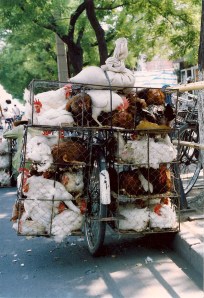
Business as Usual
In Chongqing, it was only a matter of time before moving again. The tourist in me stood aside for the survivor. Our stay was not welcome. We needed to go. A plane was leaving for Guangzhou, formerly Canton, the very next day. The three of us booked seats on it. We landed in Guangzhou and headed to the River where we could catch a ferry out to Hong Kong.
Our last hurdle was to slip through border security without them finding my film, giving police many tell tale pictures of the student leaders and people and events in Tiananmen Square. I had four undeveloped roles in plastic canisters. The pictures could be dangerous in the wrong hands. I thought of destroying them, but thought I could make it. As well, who would believe me that I was there, other than my mother. I could get them through these guys as we were so far from Beijing. Heading to the ferry terminal and customs, they were tucked from my bag into my socks. My heart picked up a few beats.
While I did not wear a Canadian flag on me, like many of Canuck travelers of the day, I did go in there with a friendly smile and outgoing. The border police were bolstered by a line of grim soldiers standing behind them. It was a tense exchange, but I kept loose and played the inconvenienced tourist.
“Have you been to Beijing” they asked searching through the backpack? I had had to answer yes. They could easily find out. They asked when I left it and showed them my train ticket. “I am a businessman from Canada and just seeing the sights in China. I am a bit upset we need to leave but I love your country and I will be back.” I was looking tired and a bit irritated, but clearly they were more happy to see we foreigners leave. I stuffed my belongings back into the pack. They nodded and let me board that overnight ferry. On the gangway, I drew a deep breath of relief.
Later that night, alone, I found myself crouched on the foredeck. A typhoon was coming and the wind howled. But I did not care that I could be blown off the boat in the dark. It felt good to be alive, even as the winds of the approaching storm whipped my face. I wanted to suck the air of freedom and thank God that I had made it out safely. I thought of the mayhem left behind.
In all I had been there only two weeks, but I sensed I was dropped in the middle of history for a reason. I thought of the people, the youth and idealism of the students, and how they might be now. Many would be dead, in jail or on the run. It was sad and I needed time to put it in perspective.
As the wind ripped up the Pearl River Delta and through my jacket, I worried about dear mother. She had not heard from me since before heading into China, and the crackdown was reported widely around the world. It had been almost a week since the Army marched into the Square. As soon as we tied up in Hong Kong the next morning, I looked for the first phone. Mom let out a little yell when she heard my voice. It was the best call, she said, she ever got.
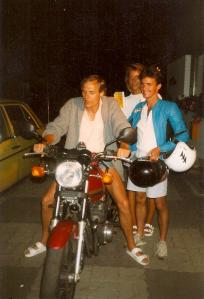
Back to Safety
That was 25 years ago today. The adventure of life was to get better. Flying out from Hong Kong in the next few days, I landed in Munich, bought another motorcycle and saw much of Europe. I even stopped in to East Germany through Checkpoint Charlie. Never shy to explore, I took up a seat in an East Berlin café not far from the Wall, and chatted with the East Berliners sitting around me. Of course they thought about getting out, to start a new life. But it was impossible. The Berlin Wall would never come down. Life under communism there was terrible. But it would not change. It was only 3 months before it did. It was an amazing year to be exploring the world.
A motorcycle is a very good place to think. While cruising along the countryside of Germany, Denmark and up to Sweden, I thought much about what had just happened. I also got a chance to read the Western press and learn of the global reaction to the events June 4th.
People and governments everywhere condemned the Chinese leaders for the brutal crackdown. I understand even more why they might think that way. To me, I knew there was no need for it. The students were leaving. Had the Army waited until June 5th, most of the students would be back in class.
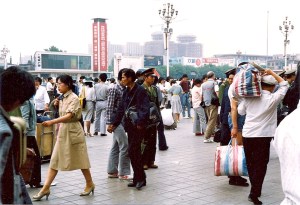
Army Presence at Train Station
Which led me to deeper thought. They knew the students were about to go. The government would have had infiltrators inside the student’s circle, it would be so easy to do. It was no secret the students were wrapping it up after the weekend. In that scenario, Deng Xiaoping and the old guard did not intend to just ‘clear the Square’. It was far more strategic. They wanted to send a message to all students and others all over the country. They did not want to see this again, for a very, very long time. It had to be the primary reason to open fire on your people. The crackdown was not just about today. It was more about the future.
It would make for a very interesting ‘case’ such as the ones we used to study in business school. Harvard, Ivey and many other top business schools used real life ‘cases’ or examples to explore options and decisions that others had faced. There are many sides to any event and I wonder if anyone would have the nerve to explore the events and decisions of Tiananmen Square, from all perspectives. I doubted it. I would come to explore this idea further, but for now it was time to see Europe.
That perspective would come with time. After my year of adventure, I would settle in Sweden, work for Swedish Development Consulting Partners, an international development consultancy. I would go later back to China several times on economic and environmental development missions, and into former communist East Bloc countries that became democracies.
It would be interesting one day to explore the actions of the students and China leaders and set them in the context of world developments.



 Peter Ormesher - News & Views